GENERAL APPEARANCE
The first impression of a good BB sheep is that of a noble animal, strong, alert, well muscled and clean cut, unlike its woolly cousins of the temperate world. The sheep is as tall as it is long. It gives the impression of muscular fitness without any look of clumsiness or softness. The ideal sheep is stamped with a look of quality and nobility-difficult to define, but unmistakable when present. Secondary characteristics are strongly marked in the adult, thus clearly identifying the ram from the ewe at first look.
HEAD
The head is noble with a typical "roman" nose. The head of the ram is distinctly masculine and that of the ewe feminine. The muzzle is wide and strong with firm lips. The lower jaw is colored black. Incisor teeth must meet the dental pad.
EARS
The ears are pointed and when alert stick out from the side of the head parallel to the ground. The inside of the ears is black. Some variation in the size of ears is permitted. Floppy ears and half ears or less ("elf" ears) are discriminated against.
EYES
The eyes are brown in color and almond shaped. A wide black mark runs from the base of the nose on each side to the crown of the head. Inverted eyelids are discriminated against.
POLL
Barbados Blackbelly rams are polled or may have small, loose scurs. Ewes are polled.
NECK
The neck is strong and muscular, clean cut without loose folds of skin. Occasionally wattles are found, but are discriminated against. In the case of an adult ram, a mane is present covering the neck right down to the chest. An armor of coarse hair covers the entire neck.
FOREQUARTERS
The shoulders are laid on flat and both the upper arm and the shoulder blade are well muscled. The forelegs viewed from the side are straight. The pasterns are strong and springy; these sheep are known for their jumping ability. The forelegs are black on the front from the knees down.
HINDQUARTERS
The hindquarters should be muscular with a long sloping croup (rump). The hind legs viewed from behind should be straight. Any tendency to cow hock or bandiness (pulled together as tied together) is discriminated against.
FEET
The hooves should be well formed and kept trimmed and should show no signs of foot rot.
BODY CAPACITY
Body capacity should be relatively large in relation to the size of the animal. The body should be deep and wide with well-sprung ribs.
TOPLINE
The withers are higher than and sloping into a level back. The loin viewed from the top should be broad and strong. The croup (rump) should be long and gradually sloping. Short steep croups are to be discriminated against.
TAIL
The tail should be long, reaching to the top of the hocks as the sheep is walking. The tail should not be docked. The color should blend in, with the exception of a distinct white tip of no more than 1 1/2 in. being permissible.
COAT
The ideal BB sheep has a coarse hair coat. There should be lanolin to repel ticks and other ectoparasites. Some wooliness is tolerated. A wooly coat that is not shed is a disqualifying trait. The sheep should not be shorn.
COLOR
The color is typical of the breed with a black belly. The color on top of the back can vary from light fawn through brown to reddish brown.
GOALS FORIMPROVINGTHE BREED
We prefer improvement through selective breeding over out-crossing and purging to preserve the genes and qualities of the sheep originally imported from the Island of Barbados. This is what we call "preserving the integrity" of the breed and is of utmost importance.
Some important things to select in your brood stock:
Slick hair with smooth blending colors
Strong bones and soundness
More muscled legs and backs for more choice meat
Ewes with a larger carrying capacity for multiple fetal deliveries and larger lambs
Ewes with adequate udders
Ewes with a large pelvis for ease in birth
Ewes with non-seasonal estrus and quick breed-back
Ewes with good maternal instinct
Rams that hold their heads high when alert
Stock that reproduces the best qualities
Ewes with black on the back of the udders all the way up and on the underside of the tails
Rams with a black mane all the way down the front of the neck
Parasite resistance
Early puberty


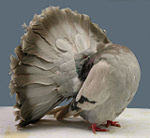
 Emmm nampaknyeee tuanyeee la yang tak ade jodoh !!! yg penting i nampak sendiri my snow fantail make love dikala senja nan merah berlabuh!!!tak sabar nak tgu dapat baby niee!!!! harap-harap dapat anak kembar!!! ok!!
 EEmmm klu ikut kan hati hendak je beli this spesis tapi mahal sangat la sampai 15k sepasang!! hanya mampu lihat Tan sri punya(mai farm) je yang sekarang dah dapat baby!!! tapi tak pe la azam tahun 2010 kumpul duit dulu nanti klu ade duit sket nak beli gak laaa!!! tapi yang confiuse kena ada lesen la plak!! scary la plak!! dah la nak dapatkan mahal end up kena masuk lokap plak!! scary la
 Sob!!sob!! sodeh laa femail ringneck tempang tak tahu kena apa!! rasa-rasa ada pemangsa la sbb malam 2 ade bunyi bising kat cage dia!! ayam-ayam kampung habis terbang keluar reban!! yang menjadi tanda tanya adakah ianya musang berjangut atau cik tie....kus yang selalu mencuri my little chick!!so kepada sesapa ade petua atau tok bom boleh la bagi petua supaya tiada ganguan di malam hari ye!!!

.jpg)


%5B1%5D.jpg)